digital-isolator-2t6r
The digital-isolator-2t6r is a board containing two digital isolators, providing a total of 2 TX channels and 6 RX channels. The board supports digital isolators with SOIC-16W package. A diagram of the board is shown in Fig. 18, where:
\(\text{V}_\text{DDA}\)/\(\text{GNDA}\) and \(\text{V}_\text{DDB}\)/\(\text{GNDB}\) are the supply to each side.
\(\text{RX1}_\text{A}, \dots, \text{RX6}_\text{A}\) are the RX pins on side A.
\(\text{TX1}_\text{A}\) and \(\text{TX2}_\text{A}\) are the TX pins on side A.
\(\text{RX1}_\text{B}\) and \(\text{RX2}_\text{B}\) are the RX pins on side B.
\(\text{TX1}_\text{B}, \dots, \text{TX6}_\text{B}\) are the TX pins on side B.
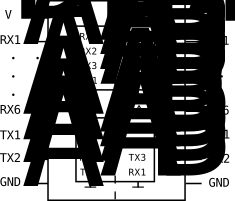
Fig. 18 Diagram of the board.
Note
TX and RX pins are defined with respect to the board. Thus, TX pins on the board are outputs, and RX pins are inputs.
Note
The board is denoted 2t6r based on the number of TX and RX of side A. This is typically the side that would be connected to the target application, while side B is connected to the controller (thus providing the controller with 2 TX and 6 RX channels).
Board and pinout
A fully populated board is shown in Fig. 19. The two TX signals and six RX signals are on the left (connector J2). The board’s pinout is shown in Fig. 20.
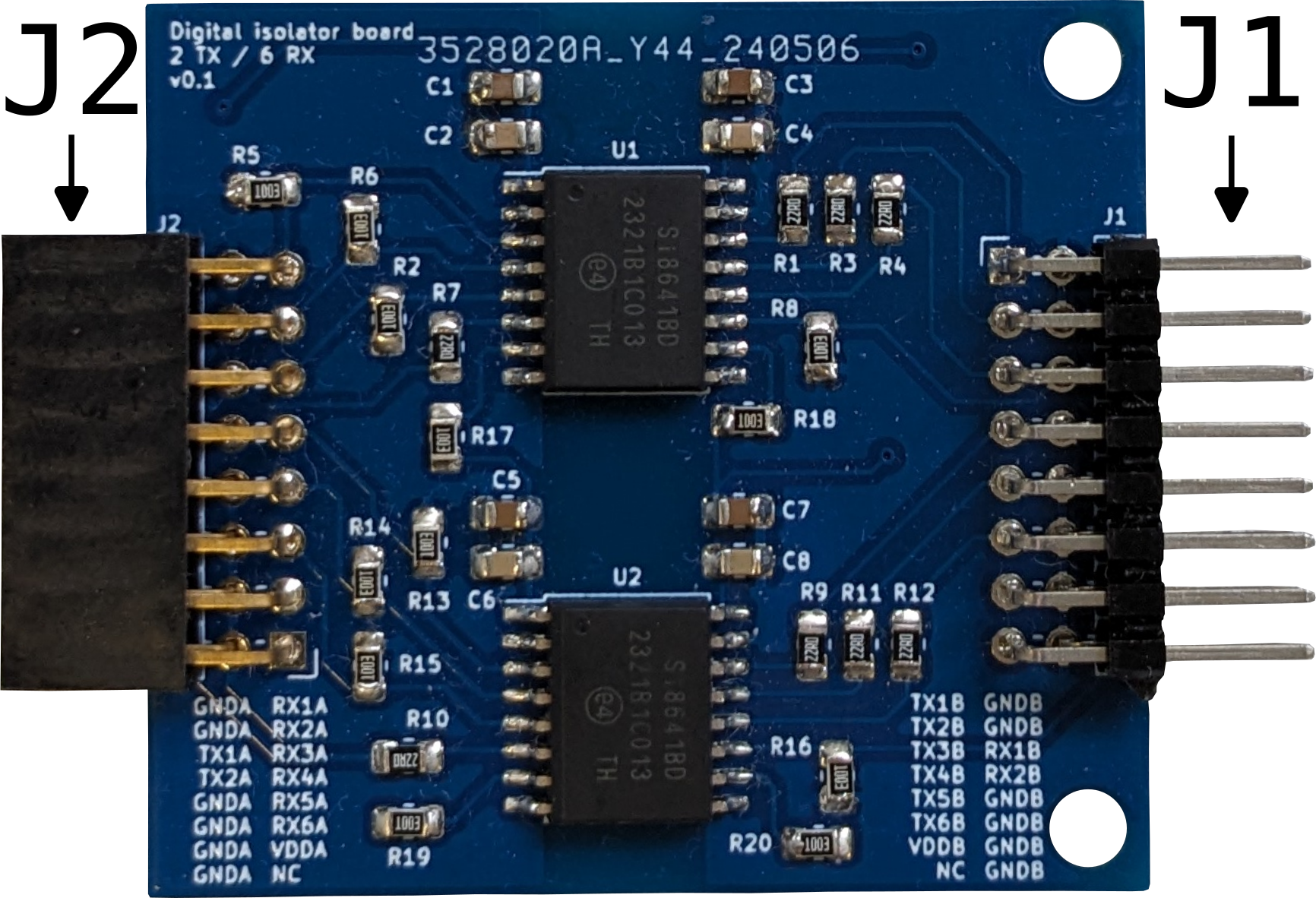
Fig. 19 Populated board.
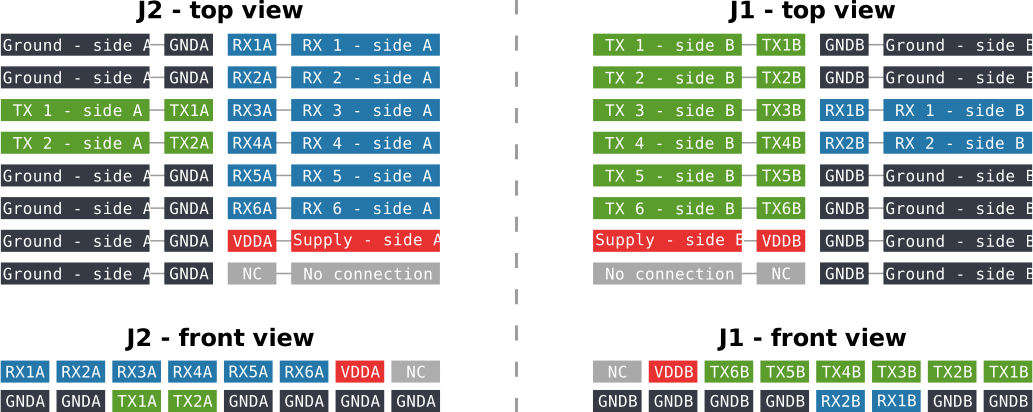
Fig. 20 Pinout of the board.
Digital isolator compatibility
The board supports any isolator having the footprint shown in Fig. 21. Example of compatible isolators:
Analog Devices’ ADuM1401
Texas Instruments’ ISO6741
Skyworks’ Si8641
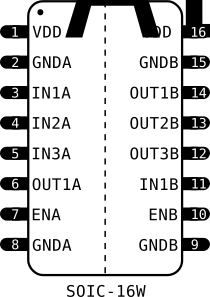
Fig. 21 Isolator’s footprint.
Note
The ENA and ENB pins are connected to their respective VDD pins on the board through a pull-up resistor. Should you instead need a low level on ENA/ENB to enable the chip, it is possible to simply do a solder bridge between EN and GND on the board.
Note
The footprint of the isolator of this board is the same as in the digital-isolator-6t2r board.
Isolator diagram
The diagram of a single isolator is show in Fig. 22. TX lines contain a series resistor to help with ringing in case of driving capacitive lines. In most cases, a value of 10R-47R should be enough. The inputs contain a pull-down resistor to prevent floating signals at the input of the isolator. These might not be necessary depending on the part used. For example, ADuM1401 does not contain any pull down resistors (see here and here), while ISO6741 might (see here).
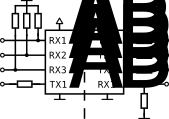
Fig. 22 Diagram of single isolator.
Usage as 6 TX and 2 RX
If this board has 2 TX and 6 RX channels on side A, and I need 6 TX and 2 RX channels instead, can’t I simply use the board through side B instead? Why is there a digital-isolator-6t2r board for this purpose?
Using the board from side B to get 6 TX and 2 RX channels is perfectly fine. Note, however, that the connections will be mirrored.
In order to keep the same connections, but reversed TX and RX, board was digital-isolator-6t2r designed. The main motivation for this is designing a single connector board for a controller that has a standard type of connector, and different applications would use different boards depending on the number of required TX and RX channels.
Note
TODO: mention relation to pynq adapter board.
Why this number of channels?
Originally, the board was intended to be used along the adc-board-six-channels, to provide digital isolation. Thus, the number of TX and RX were chosen to be compatible with the ADC board.
Application example
Fig. 23 shows one example where the digital-isolator-2t6r board was used. In the example, the board was used to provide isolation between a controller and an experimental dc-dc converter. More specifically, the board was used to isolate the adc-board-six-channels from the controller, thus providing the controller with isolated measurements. The board used Si8641 chips with clock signals as high as 16.7 MHz.
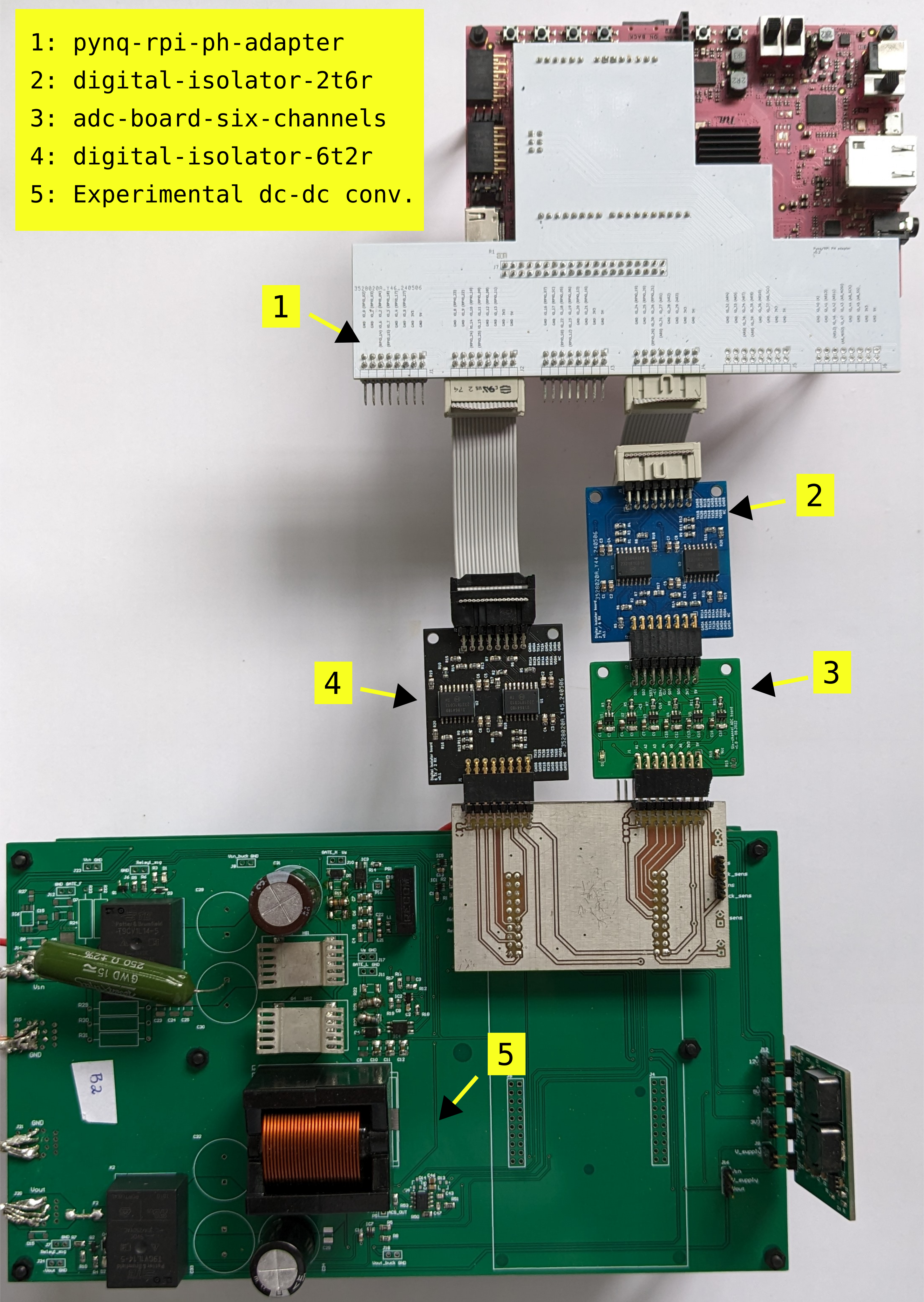
Fig. 23 2T6R isolator board put to use.
Fabrication files
To get the gerber files used to fabricate the isolator board, checkout commit b51d6b563e844d826048459c406fef7229853c5a, and find the files under digital-isolator-2t6r/gerber.